Isolate the drive before close inspection
Only trained, authorized personnel should inspect or service the drive. Stop the machine, isolate and lock or tag every hazardous energy source, control stored energy, and verify de-energization before removing the guard or touching the belt. Observe a running drive only from a safe position behind a compliant guard under the site procedure; stop and isolate it again before any adjustment.
A damage pattern is evidence, not a verdict. The same appearance can have several possible causes, and one drive fault can produce several symptoms. Preserve the failed belt, record the operating context, and confirm the diagnosis with measurements and the exact manufacturer data for the belt and the equipment.
Preserve evidence before diagnosing
Use this sequence so the investigation does not destroy the evidence or create another hazard:
- If the site permits guarded observation, record noise, vibration, tracking, startup behavior, and the load condition from a safe position without touching the drive. Stop promptly if continued operation is unsafe.
- Apply the site energy-control procedure: isolate and lock or tag every energy source, restrain or dissipate stored energy, verify de-energization, and only then remove the guard.
- Photograph the installed drive before cleaning or removal. Capture both sidewalls, the top and inner surface, fracture faces, every belt in the set, sheave grooves, idlers, the guard, and nearby contamination.
- Record the exact belt designation, manufacturer and product family, installation date or operating hours, tension value and method, shaft speeds, load, starting method, recent changes, and when the symptom appeared.
- After removing the belt without prying, gauge the sheave grooves and inspect alignment, sheave and idler diameters, bearings, shafts, mounts, take-up, guarding, debris, and evidence of center-distance movement.
- Retain the failed belt or complete set in its observed condition. If evidence remains ambiguous, send the record and parts to the belt manufacturer or qualified application engineer before approving a critical-drive restart.
Observation, candidate causes, checks, and next action
Failure-diagnosis reference
Each row holds one observation, the candidate causes that fit it, the checks that separate them, and the safe next action. Appearance alone selects no cause.
| Observed damage pattern | Candidate causes that fit | Checks that discriminate | Safe next action or escalation |
|---|---|---|---|
| Broken belt, fractured cord, or cord damage | Drive capacity below the load; belt rolled or levered onto the sheave during installation; foreign object; severe shock; overload | Preserve the fracture; record load, start method, and recent changes; inspect the installation record, guard, and debris; confirm the exact drive rating | Do not refit a belt on the same arrangement; correct the confirmed cause or escalate to the drive or equipment owner |
| Missing rubber, delamination, or undercord separation | Sheave or back idler below the exact minimum diameter; impact or debris; installation damage; shock or overload; incompatible exposure | Measure the installed diameters; check idler position, groove condition, guarding, duty, and the storage and exposure history | Replace the affected belts as a set and record the minimum-diameter basis; escalate when the design cannot meet it |
| Shiny, burned, or hardened sidewalls | Slip; worn or undersized sheaves; drive capacity below the load; movement of the shaft centers | Measure tension against the exact specification with a calibrated instrument; gauge the grooves; check mounts, take-up, alignment, and load | Restore the specified tension and groove condition; escalate capacity or geometry changes to the drive engineer |
| Cracks on the inner compression surface | Small sheave diameter; slip; small back idler; storage distortion | Verify the exact minimum diameters, measured tension, idler layout, and storage history; compare the product family temperature limit | Replace the belt and record the corrected geometry; escalate when the operating temperature exceeds the product family limit |
| Turnover or a belt leaving the groove | Misalignment; incorrect or worn groove profile; low tension; shock or pulsation; vibration; long spans or idler effects | Check angular and offset alignment, groove fit, shaft and bearing condition, runout, span behavior, and duty | Correct alignment, tension, and groove condition; escalate joined or banded construction to the belt manufacturer with the exact drive data |
| One-sided sidewall or edge wear | Misalignment; belt-to-sheave mismatch; cord damage; shaft or bearing movement; guard interference | Check angular and offset alignment, groove profile, runout, bearings, mounts, and guard clearance | Correct the alignment or component before fitting a belt; escalate bearing or mount defects to the equipment owner |
| Flaking, sticky, softened, or swollen surface | Oil, grease, solvent, coolant, or chemical contamination; heat exposure; an incompatible fluid | Identify the source; compare the exposure with the exact product family chemical and temperature limits; inspect the neighbouring components | Stop the source and clean by the approved method; replace affected belts; escalate fluid selection to the equipment and belt manufacturers |
| Squeal, chirp, slapping, rubbing, or unusual dust | Slip or contamination; low tension or misalignment; guard interference; wrong or worn components | Record when the sound occurs and under which load; isolate and check tension, alignment, grooves, debris, guard, and belt fit | Keep the drive isolated until a confirmed cause is corrected; escalate repeated noise that has no visible damage |
- Candidate causes that fit
- Drive capacity below the load; belt rolled or levered onto the sheave during installation; foreign object; severe shock; overload
- Checks that discriminate
- Preserve the fracture; record load, start method, and recent changes; inspect the installation record, guard, and debris; confirm the exact drive rating
- Safe next action or escalation
- Do not refit a belt on the same arrangement; correct the confirmed cause or escalate to the drive or equipment owner
- Candidate causes that fit
- Sheave or back idler below the exact minimum diameter; impact or debris; installation damage; shock or overload; incompatible exposure
- Checks that discriminate
- Measure the installed diameters; check idler position, groove condition, guarding, duty, and the storage and exposure history
- Safe next action or escalation
- Replace the affected belts as a set and record the minimum-diameter basis; escalate when the design cannot meet it
- Candidate causes that fit
- Slip; worn or undersized sheaves; drive capacity below the load; movement of the shaft centers
- Checks that discriminate
- Measure tension against the exact specification with a calibrated instrument; gauge the grooves; check mounts, take-up, alignment, and load
- Safe next action or escalation
- Restore the specified tension and groove condition; escalate capacity or geometry changes to the drive engineer
- Candidate causes that fit
- Small sheave diameter; slip; small back idler; storage distortion
- Checks that discriminate
- Verify the exact minimum diameters, measured tension, idler layout, and storage history; compare the product family temperature limit
- Safe next action or escalation
- Replace the belt and record the corrected geometry; escalate when the operating temperature exceeds the product family limit
- Candidate causes that fit
- Misalignment; incorrect or worn groove profile; low tension; shock or pulsation; vibration; long spans or idler effects
- Checks that discriminate
- Check angular and offset alignment, groove fit, shaft and bearing condition, runout, span behavior, and duty
- Safe next action or escalation
- Correct alignment, tension, and groove condition; escalate joined or banded construction to the belt manufacturer with the exact drive data
- Candidate causes that fit
- Misalignment; belt-to-sheave mismatch; cord damage; shaft or bearing movement; guard interference
- Checks that discriminate
- Check angular and offset alignment, groove profile, runout, bearings, mounts, and guard clearance
- Safe next action or escalation
- Correct the alignment or component before fitting a belt; escalate bearing or mount defects to the equipment owner
- Candidate causes that fit
- Oil, grease, solvent, coolant, or chemical contamination; heat exposure; an incompatible fluid
- Checks that discriminate
- Identify the source; compare the exposure with the exact product family chemical and temperature limits; inspect the neighbouring components
- Safe next action or escalation
- Stop the source and clean by the approved method; replace affected belts; escalate fluid selection to the equipment and belt manufacturers
- Candidate causes that fit
- Slip or contamination; low tension or misalignment; guard interference; wrong or worn components
- Checks that discriminate
- Record when the sound occurs and under which load; isolate and check tension, alignment, grooves, debris, guard, and belt fit
- Safe next action or escalation
- Keep the drive isolated until a confirmed cause is corrected; escalate repeated noise that has no visible damage
Source: SQUAREROPE Technical Team; confirm every candidate cause against the exact belt, sheave, and drive manufacturer data
The matrix narrows the candidates. The intervals that keep a corrected drive in service belong in a planned program, and the V-belt preventive maintenance schedule organizes the same checks and replacement triggers by duty, wear, and risk.
Breaks, missing rubber, and inner-surface cracks
A clean break does not identify one root cause. Drive capacity below the load, belt damage from rolling or levering it onto the sheave, an object entering the guard, and severe shock can all produce a break. Delamination or undercord separation can also follow a sheave or back idler running below the product’s minimum diameter. Compare the installed geometry with the exact family data before ordering a replacement.
Inner-surface cracking needs several checks as well. A small sheave diameter, slip, a small back idler, and storage distortion all belong on the list. Do not assume a molded-notch construction removes cracking, and do not apply a universal small-sheave allowance: read the diameter, speed, tension, and idler tables for the exact family.
Shiny, hardened, sticky, or swollen surfaces
Shiny, burned, or hardened sidewalls are consistent with heat generated by slip, but worn grooves, drive capacity below the load, movement of the shaft centers, and heat exposure can leave the same evidence. Measure rather than add tension by feel, and gauge the groove with the correct tool before installing another belt.
A flaking, sticky, softened, or swollen surface points toward oil, solvent, coolant, or chemical contamination. Stop the source, do not use belt dressing, compare the exposure with the exact product family’s chemical and temperature limits, and replace a belt that falls outside the manufacturer service criteria. Do not prescribe CR, NBR, or another compound from appearance alone.
Turnover, running out of the groove, and one-sided wear
Turnover and one-sided wear require a system check, not an automatic belt substitution. Inspect angular and offset alignment, belt-to-groove fit, groove wear, shaft runout, bearings, mounts, tension, span behavior, idlers, shock, pulsation, and vibration. A straightedge check is valid only when the two groove-to-face offsets match; otherwise use the equipment or belt-manufacturer method.
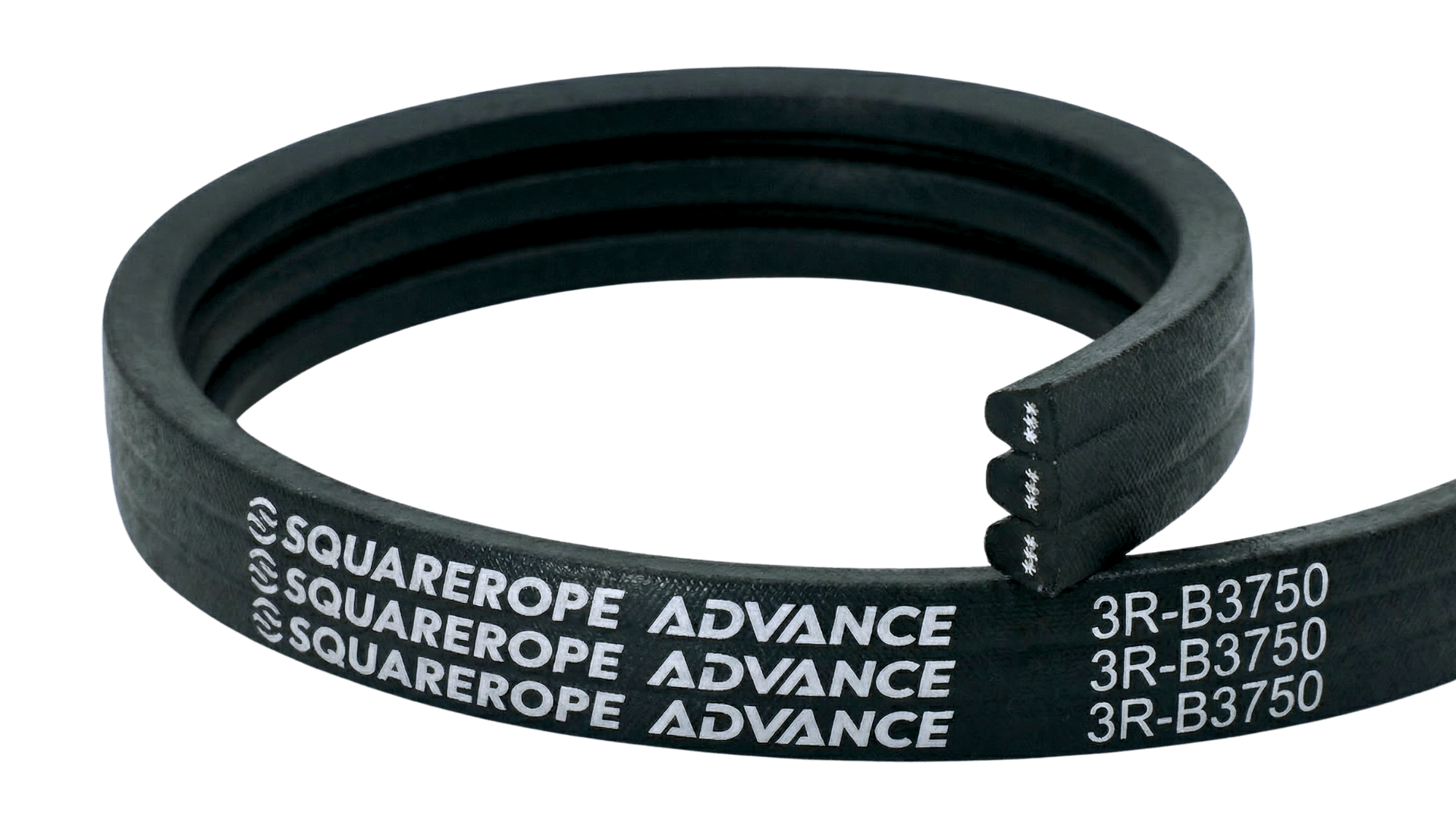
A belt manufacturer may specify a joined or banded belt for a pulsating, shock-loaded, or high-vibration drive because the tie band adds lateral rigidity. It is not a universal cure and it does not make turnover impossible: the exact belt, compatible groove spacing, rating, alignment, and tension still have to be verified.
Correct the drive, not only the damaged belt
Correct the verified cause before fitting the replacement. That may mean repairing a guard or mount, removing contamination, replacing worn sheaves, correcting alignment, changing a sheave or idler diameter, redesigning capacity, or applying the exact manufacturer tension. More tension is not a general cure for slip.
On a multiple-belt drive, replace the complete matched set from one manufacturer; never mix used and new belts, or belts from different manufacturers. Reinstall the compliant guard, clear the area, restore energy under the site procedure, and perform a controlled test from a safe position. Stop and isolate the drive again before any adjustment.
Build a failure record
Keep these items with the maintenance record and any belt-manufacturer review:
- Exact belt manufacturer, product family, designation, construction, and matched-set information.
- Installation date, operating hours, failure date, and previous belt history.
- Driver and driven equipment, shaft speeds, transmitted load, start method, starts per day, shock or pulsation, and daily hours.
- Photographs of the installed drive, every belt surface, fracture faces, sheaves, idlers, guard, and contamination.
- Measured tension, instrument and method, target source, and whether the value was taken before or after removal.
- Sheave groove gauge result, diameter basis, minimum-diameter check, alignment result, and shaft runout.
- Bearing, mount, take-up, center-distance, idler, guard, and ventilation condition.
- Temperature and exposure to dust, debris, water, oil, grease, solvents, coolants, chemicals, ozone, or sunlight.
- Differences among belts in the same set and whether old, new, or different-manufacturer belts had been mixed.
- Verified root cause, corrective action, replacement specification, belt-manufacturer approval, and guarded test result.
The useful question is not “what does this mark always mean?” but “which listed causes fit the mark and the measured drive evidence?” A documented, isolated inspection reduces the chance that the next replacement repeats the same failure.
Key Takeaway
Can a V-belt damage pattern prove the root cause?
No. A pattern narrows the candidate causes, but tension, sheave condition, alignment, load, installation, environment, and the exact manufacturer data must confirm the diagnosis.
Need help reviewing a failed belt and drive record? See V-Belt and Cogged V-Belt, or contact SQUAREROPE with photographs and operating data.