Inspect only under a safe energy-control procedure
Only trained, authorized personnel should inspect or service the drive. Follow the equipment instructions, site energy-control procedure and applicable local rules. Before removing guards or touching, measuring or adjusting the drive, shut down, isolate hazardous energy, apply the required lockout controls, make stored energy safe and verify isolation. Observe running equipment only from a safe position with guarding in place.
A banded V-belt and a Poly-V belt are different belt-and-pulley systems. The useful question is which complete system can meet the recorded duty within the available space and maintenance capability. A belt failure, a narrow appearance or a product name does not answer that question.
Recognize the two structures
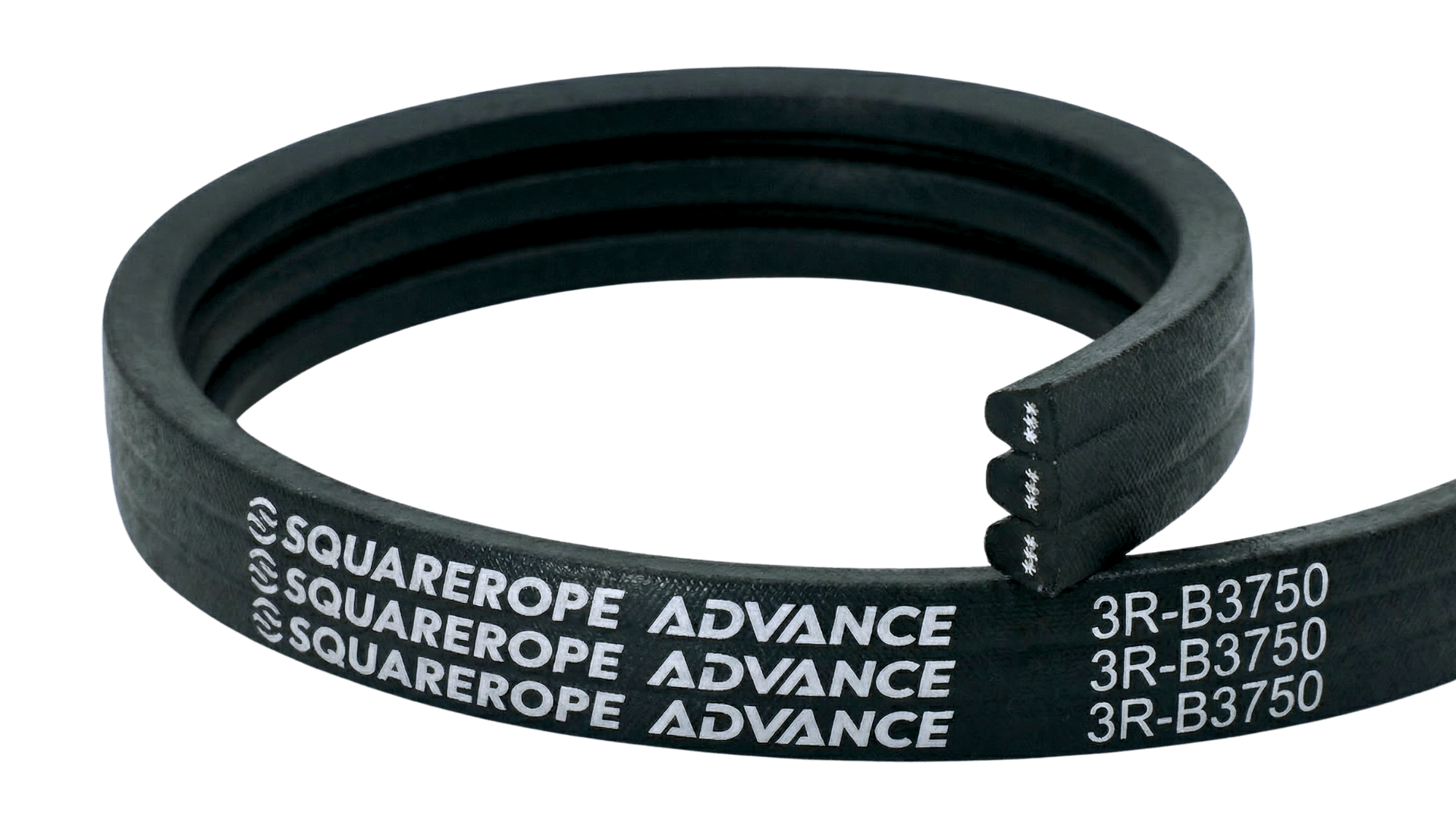
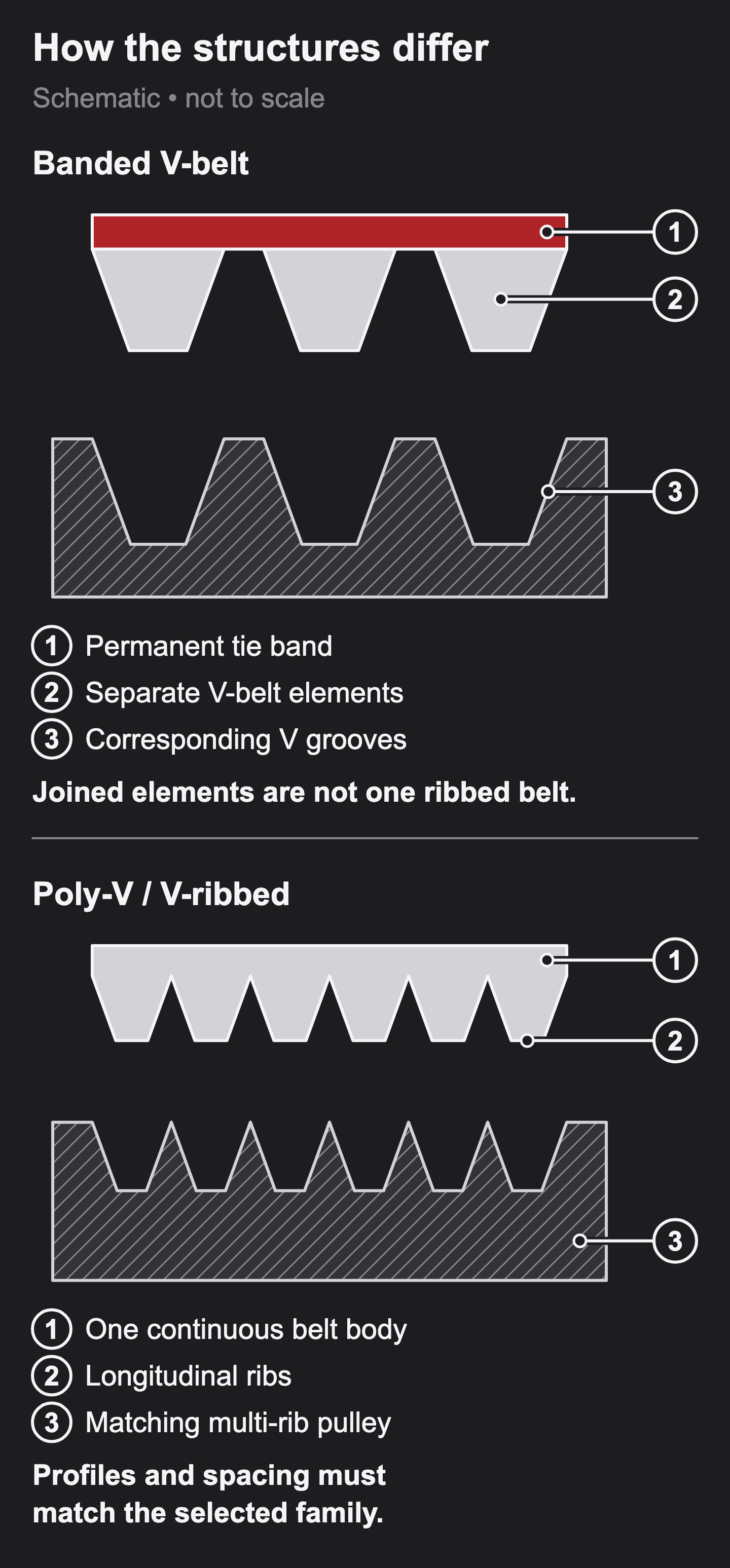
A banded V-belt joins several compatible V-belt elements with a permanent tie band. The elements engage corresponding grooves in a compatible V-belt sheave. Joining the elements does not remove the need to check the selected assembly’s section, spacing, rating and installation requirements.
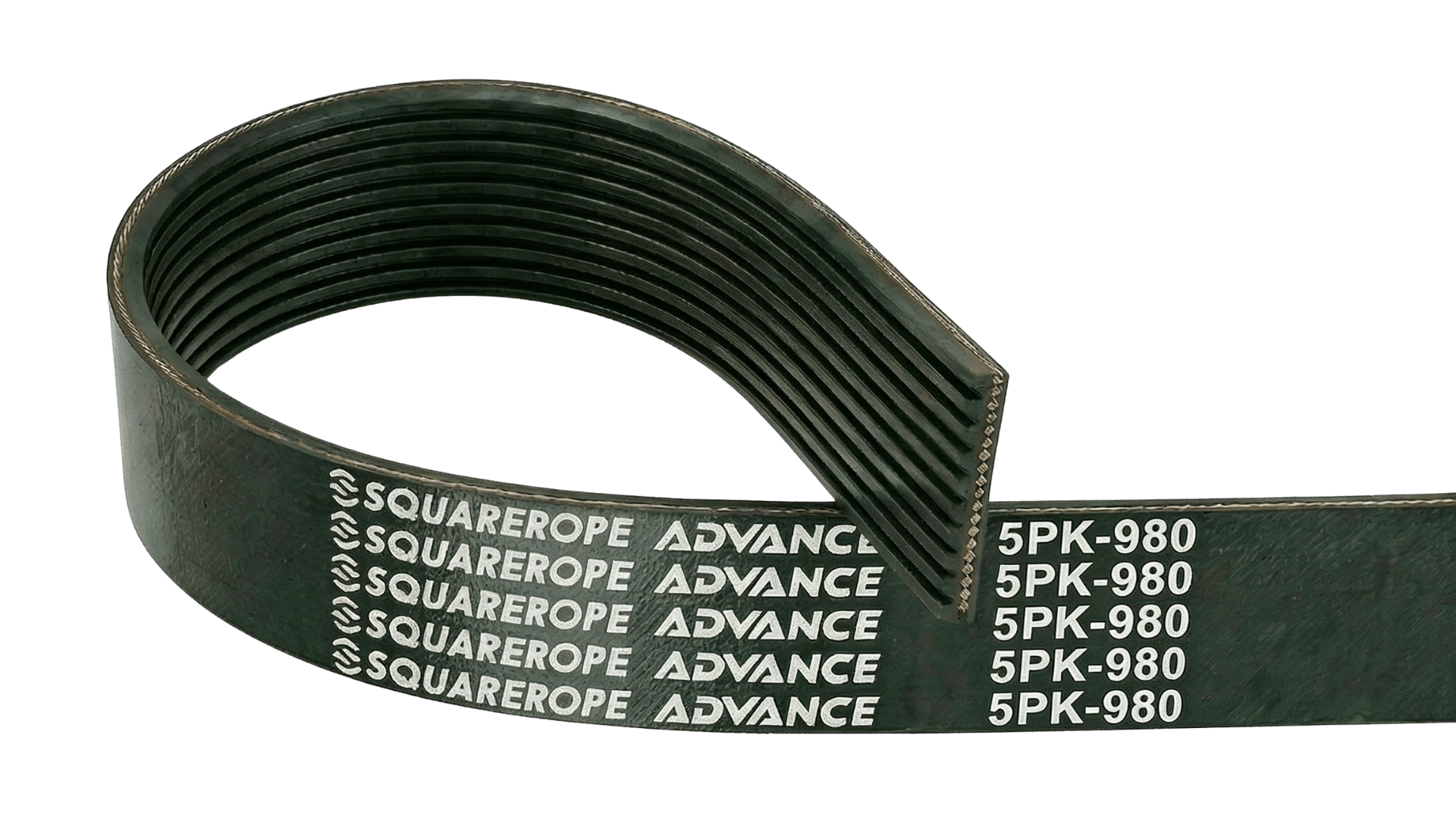
A Poly-V, or V-ribbed, belt is one belt with longitudinal ribs that engage a matching multi-rib pulley. Rib profile and count belong to that system. Ribbed construction is not the same as several conventional V-belts joined together, and neither appearance nor nominal belt width establishes pulley compatibility.
Review the construction and material distinctions in V-Belt Construction Explained: Wrapped, Raw-Edge, and Molded-Notch Belts.
Compare what the complete system needs
Selection comparison
An original SQUAREROPE checklist of evidence to collect. These rows do not rank the architectures.
| Decision axis | Banded V-belt system | Poly-V system |
|---|---|---|
| Section / profile | Verify the exact joined V-belt section and assembly. | Verify the exact rib profile and rib count. |
| Pulley geometry | Match section, groove spacing and compatible sheaves. | Match rib pitch, profile and compatible pulleys. |
| Load behavior | Check the selected family against torque, starts, shock and pulsation. | Check the selected family against the same measured duty. |
| Speed and space | Check rated speed, diameters, width and installation clearance. | Check rated speed, diameters, width and installation clearance. |
| Rating basis | Use exact-family ratings, element count and required corrections. | Use exact-family ratings, rib count and required corrections. |
| Routing / idlers | Obtain approval for each idler and layout. | Obtain approval for each idler and layout; ribs do not approve backside contact. |
| Tension | Use the assembly’s method, target and adjustment requirements. | Use the family’s method, target and adjustment requirements. |
| Alignment | Measure against the selected drive’s alignment requirements. | Measure against the selected drive’s alignment requirements. |
| Environment / maintenance | Verify material suitability, guarding and inspection access. | Verify material suitability, guarding and inspection access. |
| Supply / conversion cost | Include belts, pulleys, validation, downtime and maintenance. | Include belts, pulleys, validation, downtime and maintenance. |
- Banded V-belt system
- Verify the exact joined V-belt section and assembly.
- Poly-V system
- Verify the exact rib profile and rib count.
- Banded V-belt system
- Match section, groove spacing and compatible sheaves.
- Poly-V system
- Match rib pitch, profile and compatible pulleys.
- Banded V-belt system
- Check the selected family against torque, starts, shock and pulsation.
- Poly-V system
- Check the selected family against the same measured duty.
- Banded V-belt system
- Check rated speed, diameters, width and installation clearance.
- Poly-V system
- Check rated speed, diameters, width and installation clearance.
- Banded V-belt system
- Use exact-family ratings, element count and required corrections.
- Poly-V system
- Use exact-family ratings, rib count and required corrections.
- Banded V-belt system
- Obtain approval for each idler and layout.
- Poly-V system
- Obtain approval for each idler and layout; ribs do not approve backside contact.
- Banded V-belt system
- Use the assembly’s method, target and adjustment requirements.
- Poly-V system
- Use the family’s method, target and adjustment requirements.
- Banded V-belt system
- Measure against the selected drive’s alignment requirements.
- Poly-V system
- Measure against the selected drive’s alignment requirements.
- Banded V-belt system
- Verify material suitability, guarding and inspection access.
- Poly-V system
- Verify material suitability, guarding and inspection access.
- Banded V-belt system
- Include belts, pulleys, validation, downtime and maintenance.
- Poly-V system
- Include belts, pulleys, validation, downtime and maintenance.
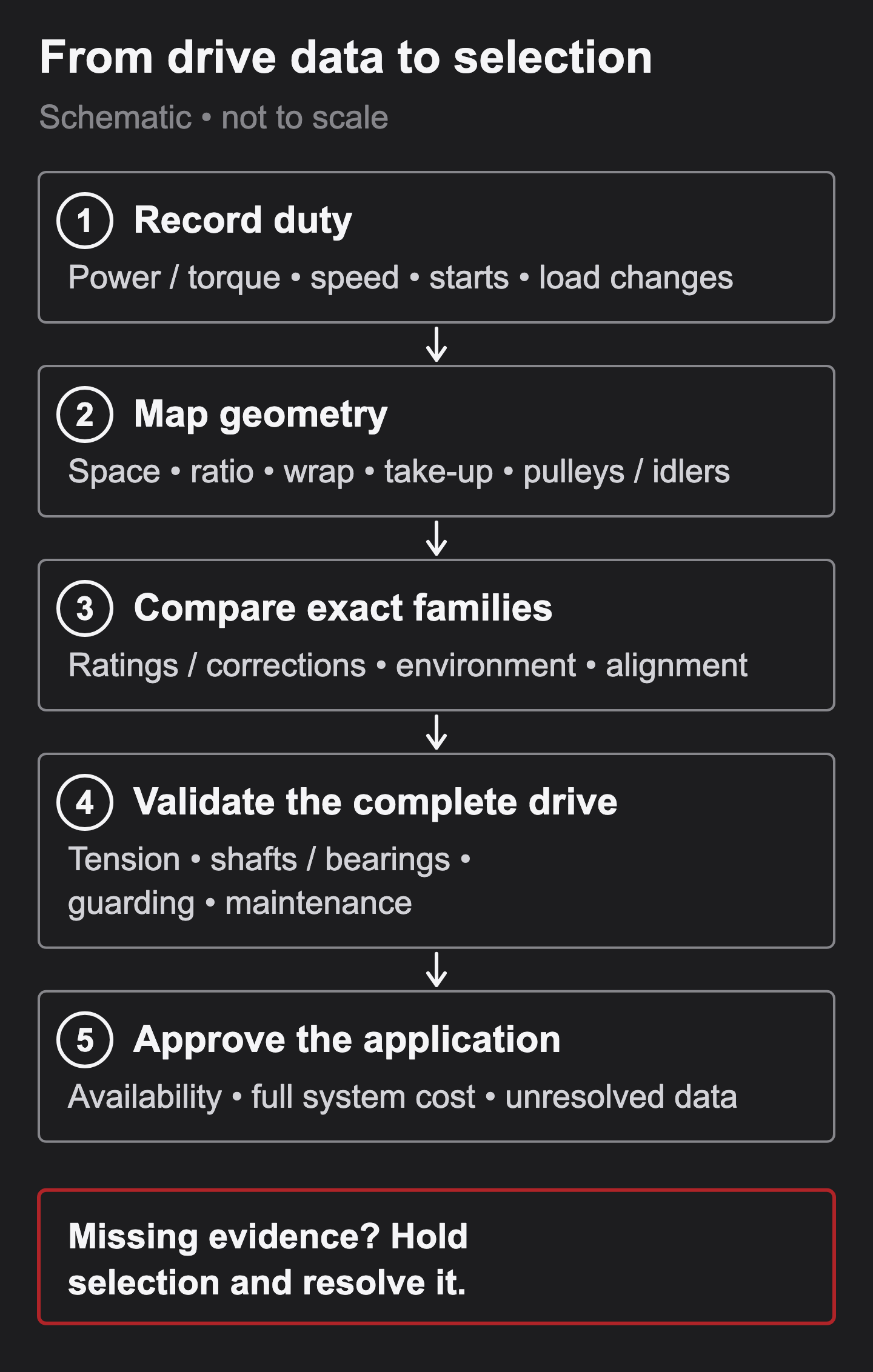
Build a selection record
Keep a written record before asking for a quotation. An unknown value is a question to resolve, not permission to substitute an assumption.
For the duty and calculation framework, use V-Belt Selection Guide: How to Specify the Correct Drive.
- Record driver and driven machine, actual power or torque, shaft speeds, starts, stops, reversing, braking, operating hours, shock, pulsation and vibration.
- Record available space, ratio, center distance, wrap, take-up travel, installation clearance, and every pulley and idler.
- Identify exact belt section or rib profile, element or rib count, length convention and compatible pulley geometry.
- Record alignment capability, shaft and bearing capacity, guarding and access for safe inspection.
- Record temperature, contamination, moisture, chemicals and any application-specific approvals; confirm the exact product’s suitability.
- Compare candidate families using current manufacturer ratings, service factors and required corrections. Do not transfer a rating or tension target between families.
- Confirm tension method and target, installation procedure, run-in or retension requirements, maintenance capability, availability and complete system cost.
- Resolve missing data with the equipment or belt supplier and obtain application approval before ordering or changing the drive.
Use damage as evidence
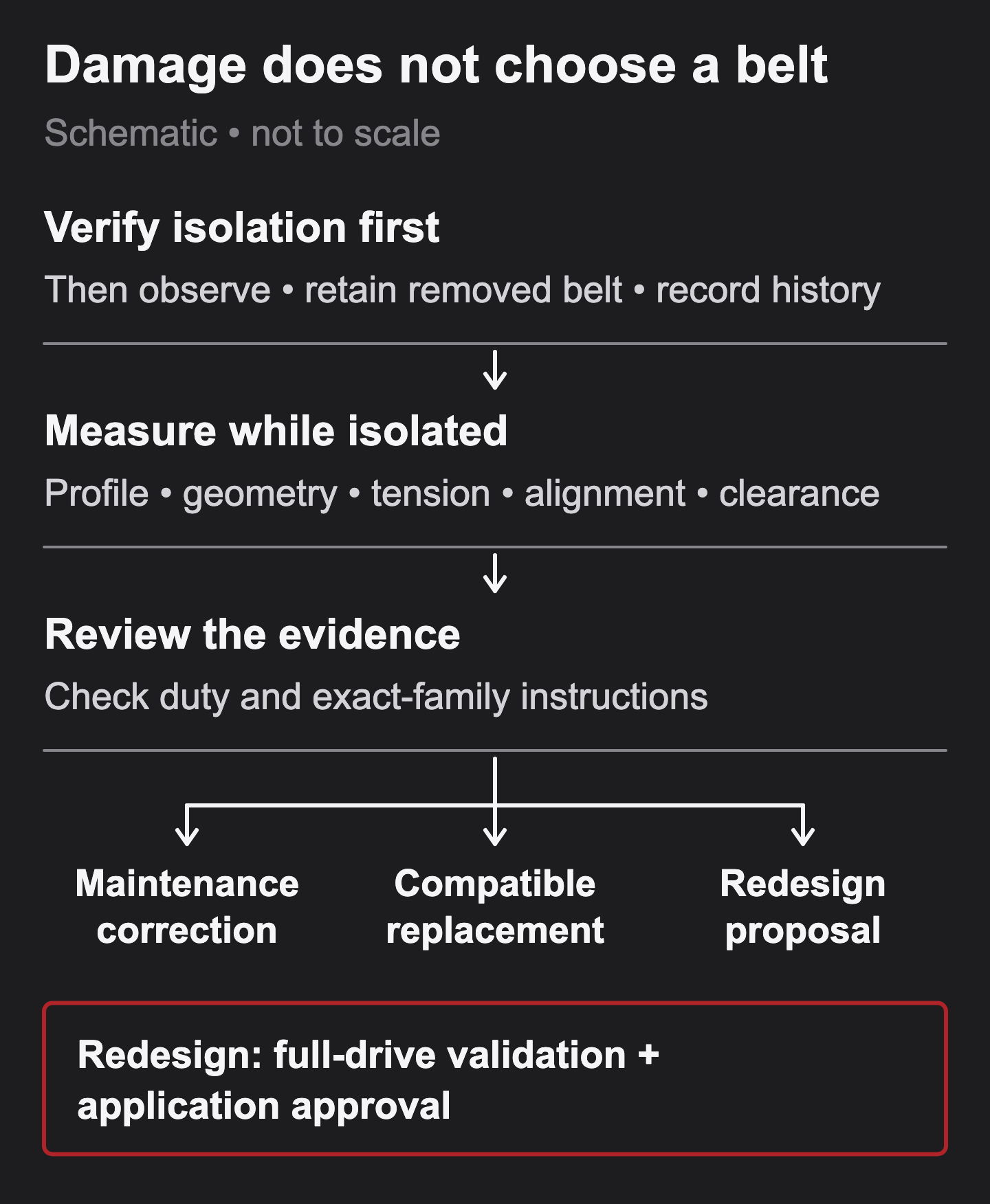
For access-dependent damage assessment, verify safe isolation first. Then record the observation: where the tie band is damaged, which element or rib shows wear, and whether an edge or the back is affected. Retain the removed belt and document its orientation and service history. A photograph records appearance; it does not prove the cause.
Under safe isolation, check identification, pulley condition and geometry, alignment, tension and adjustment, guard or idler clearance, contamination and duty against the equipment and exact-family instructions. Measure components before deciding which require replacement.
Use the findings to separate a maintenance correction, a compatible replacement and a proposed redesign. Do not infer remaining life, select a compound, or choose a different architecture from one damage mark.
Validate every conversion
Changing between banded V-belt and Poly-V architectures requires full-drive validation and application approval. A new belt is not an approved conversion kit. Do not fit a different architecture to existing pulleys on the strength of similar width or length.
Validate duty and corrected rating; section/profile and groove/rib geometry; speeds, ratio, diameters and wrap; pulleys, every idler and routing; alignment; take-up and installation; shafts and bearings; guarding; environment and material suitability; tension and maintenance; availability and complete conversion cost. If a requirement is unresolved, keep the conversion on hold.
Specify the replacement clearly
Release a specification that identifies the entire replacement system:
- Exact approved product family, belt section or rib profile and element or rib count.
- Length value with its stated length convention; no guessed cross-reference.
- Compatible pulley specification and recorded condition; each idler’s approved geometry and position.
- Rated duty and corrections, operating speeds, environment and required approvals.
- Installation clearance, take-up, alignment and shaft/bearing requirements.
- Exact tension procedure and target, inspection and maintenance instructions.
- Supplier confirmation, availability, conversion cost where relevant and the person responsible for application approval.
Read standards within their scope
ISO 9982:2021 is an ISO dimensional standard for industrial PH, PJ, PK, PL and PM V-ribbed pulley-and-belt profiles, excluding elastic belts in its published abstract. The catalogue currently lists it as published and under systematic review. This guide uses the abstract’s scope, not unaccessed dimension tables or a claim of drive approval.
OSHA 29 CFR 1910.147 is a United States hazardous-energy-control rule for covered servicing and maintenance, with scope exclusions. It is not a worldwide compliance rule. Apply the rules and equipment-specific energy-control procedure relevant to your location and task.
ISO 9982:2021 · OSHA 29 CFR 1910.147
Choose an architecture only after the complete system is validated. No universal efficiency, power, noise, vibration, life or upgrade advantage follows from either architecture name.
Key Takeaway
Should I use a banded V-belt or a Poly-V belt?
Choose an architecture only after the complete system is validated. No universal efficiency, power, noise, vibration, life or upgrade advantage follows from either architecture name.
Send the recorded duty, belt identification, pulley and idler details, environment and maintenance requirements to SQUAREROPE for a specification discussion.