Technical Insights
Solving Belt Transmission Challenges
Buy industrial V-belts from a traceable drive specification, current product evidence, supplier change control, and documented receiving checks—not appearance or shorthand alone.
Compare V-belt compounds as an initial screening step, then approve only the exact belt series whose materials, ratings, and environmental limits fit the drive.
Specify a double-V or hexagonal belt from the actual serpentine geometry, compatible pulley grooves, exact family ratings, materials, and tension data.
Specify a Poly-V belt from the exact profile, rib count, length, pulley geometry, route, product-family rating, materials, and tension data.
Compare the belt and pulley systems, collect duty and geometry data, and validate the complete drive before selection or conversion.
Treat notch damage as evidence: verify pulley and idler diameters, tension, grooves, alignment, load, contamination, temperature, and the exact belt family.
Record when the squeal, slip, heat or speed loss occurs, then confirm tension, sheave condition, alignment, contamination, load and the exact drive rating before changing parts.
Cracks, hardening, sidewall wear, turnover, and swelling narrow the investigation, but tension, sheaves, alignment, load, and environment must confirm the cause.
Set V-belt tension from the exact drive and belt-maker target, using a calibrated force-deflection gauge or compatible sonic meter—not feel.
Set V-belt inspection intervals from duty, environment, criticality, product instructions, event triggers, and recorded condition—not a universal calendar.
Plan a safe V-belt installation by controlling energy, inspecting the drive, fitting the exact belt without force, and following the governing instructions.
Select a V-belt by documenting the load, drive geometry, environment, and duty, then using the exact manufacturer’s rating and installation tables.
Learn what wrapped, raw-edge, molded-notch, and joined construction terms describe, how physical features can coexist across four independent axes, and which manufacturer data to verify.
Determine correct industrial V-belt replacement dimensions, profiles, datum and length systems, and sheave groove compatibility before ordering.
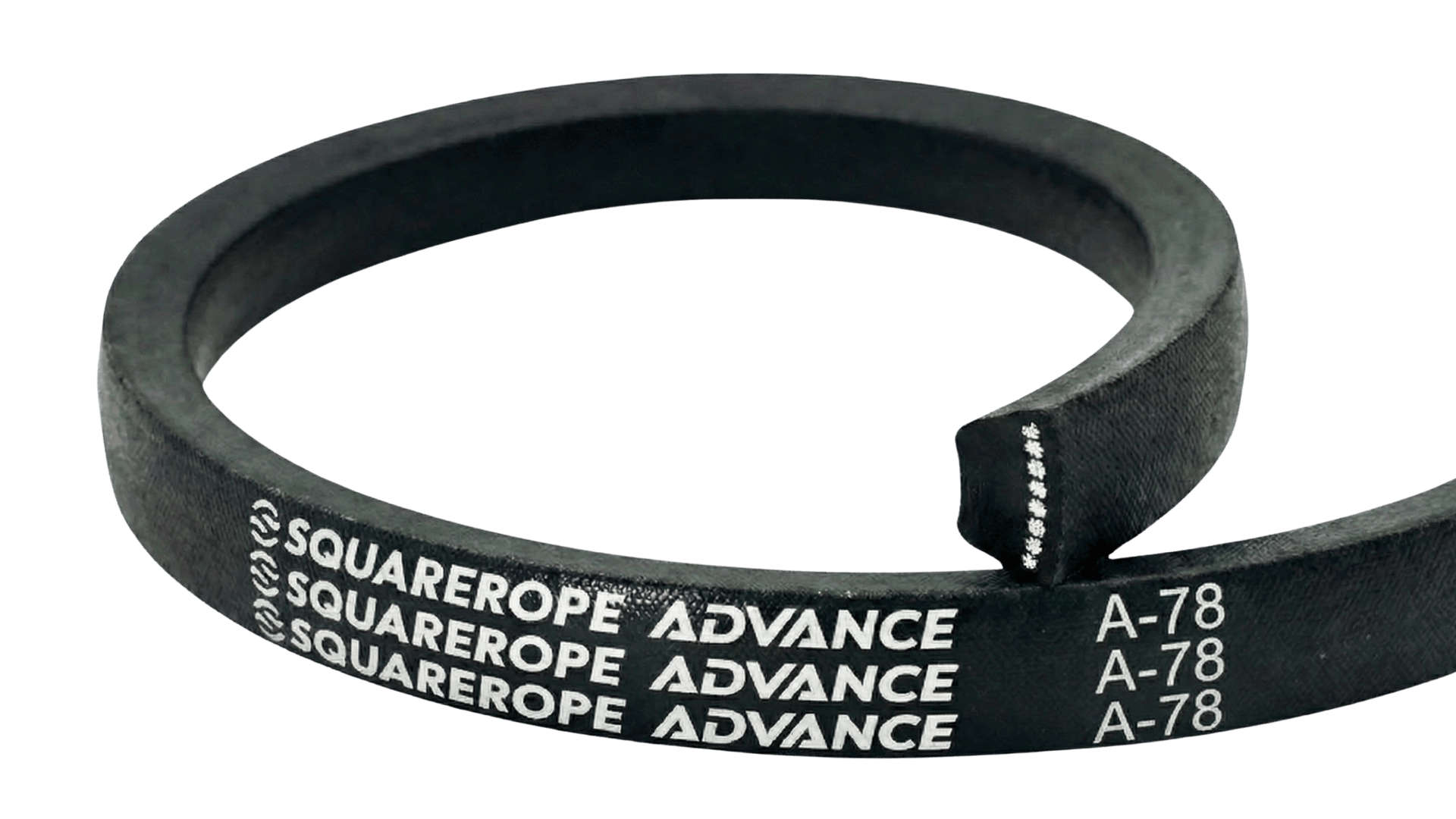
Decode the profile, construction marker, length value and basis, and strand count—then verify the exact manufacturer catalog before substituting a belt.
Identify an unknown V-belt by preserving markings, inspecting construction, measuring its cross-section and outside circumference, determining the length basis, and verifying the complete drive fit.