Inspect and measure the drive safely
Only trained, authorized personnel should inspect or service a drive. Observe operation from a safe position with compliant guarding in place. Before removing guards or touching, measuring, cleaning or adjusting, stop the machine, isolate hazardous energy, apply the required energy-control devices, make stored energy safe and verify isolation under the equipment and site procedure. Follow applicable local rules. OSHA 29 CFR 1910.147 applies to covered servicing and maintenance in the United States, with scope exclusions; it is not a worldwide compliance rule.
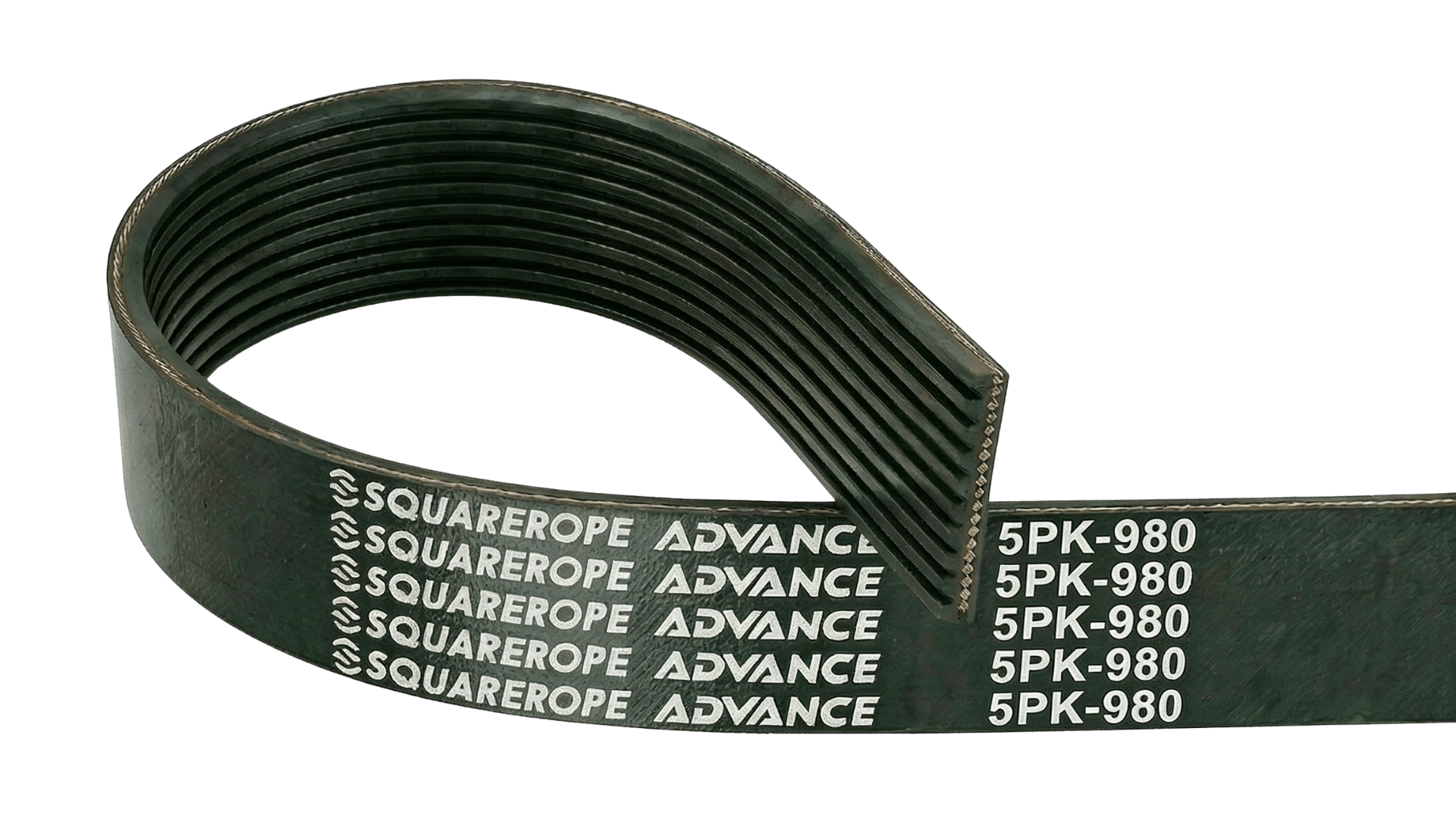
A Poly-V belt, also called a V-ribbed or multi-rib belt, is a single flexible belt with longitudinal ribs that run in matching grooved pulleys. Its profile, rib count, length, construction, route, and tension form one system. The name Poly-V alone does not prove a speed, efficiency, noise, temperature, or service-life advantage.
Understand the belt-and-pulley system
The longitudinal ribs transmit power by friction against the matching pulley grooves. A continuous belt body joins the ribs and carries the tensile member. Body materials, cord materials and backside construction depend on the exact product family; do not assume a universal CR or chloroprene construction.
Packaging, speed and every contact face must be validated for the exact product family and drive. Ribbed appearance does not approve serpentine, twisted, reverse-bend or backside contact. Where ribs must drive on both faces, select an expressly approved double-sided construction; do not infer permission to drive through an ordinary belt's back.
Identify the profile by rib pitch
Nominal profile pitch and what to verify
Nominal pitch is one identification value. Matching pitch alone does not prove full pulley compatibility, power capacity or application approval. ISO 9982:2021 covers industrial PH, PJ, PK, PL and PM belt/pulley dimensions, excluding elastic belts; its abstract does not supply the detailed dimensions used to validate a drive.
| Profile | Nominal rib pitch | What it identifies | What still requires manufacturer data |
|---|---|---|---|
| PH | 1.60 mm | PH profile identification cue; verify complete pulley geometry | Availability, length, rating, minimum diameter, speed, tension |
| PJ | 2.34 mm | PJ profile identification cue; verify complete pulley geometry | Availability, length, rating, minimum diameter, speed, tension |
| PK | 3.56 mm | PK profile identification cue; verify complete pulley geometry | Industrial or automotive family, length, rating, minimum diameter, speed, tension |
| PL | 4.70 mm | PL profile identification cue; verify complete pulley geometry | Availability, length, rating, minimum diameter, speed, tension |
| PM | 9.40 mm | PM profile identification cue; verify complete pulley geometry | Availability, length, rating, minimum diameter, speed, tension |
- Nominal rib pitch
- 1.60 mm
- What it identifies
- PH profile identification cue; verify complete pulley geometry
- What still requires manufacturer data
- Availability, length, rating, minimum diameter, speed, tension
- Nominal rib pitch
- 2.34 mm
- What it identifies
- PJ profile identification cue; verify complete pulley geometry
- What still requires manufacturer data
- Availability, length, rating, minimum diameter, speed, tension
- Nominal rib pitch
- 3.56 mm
- What it identifies
- PK profile identification cue; verify complete pulley geometry
- What still requires manufacturer data
- Industrial or automotive family, length, rating, minimum diameter, speed, tension
- Nominal rib pitch
- 4.70 mm
- What it identifies
- PL profile identification cue; verify complete pulley geometry
- What still requires manufacturer data
- Availability, length, rating, minimum diameter, speed, tension
- Nominal rib pitch
- 9.40 mm
- What it identifies
- PM profile identification cue; verify complete pulley geometry
- What still requires manufacturer data
- Availability, length, rating, minimum diameter, speed, tension
Source: Original SQUAREROPE identification checklist; listed pitches are reference values, not SQUAREROPE measurements or drive approval.
Decode the complete designation
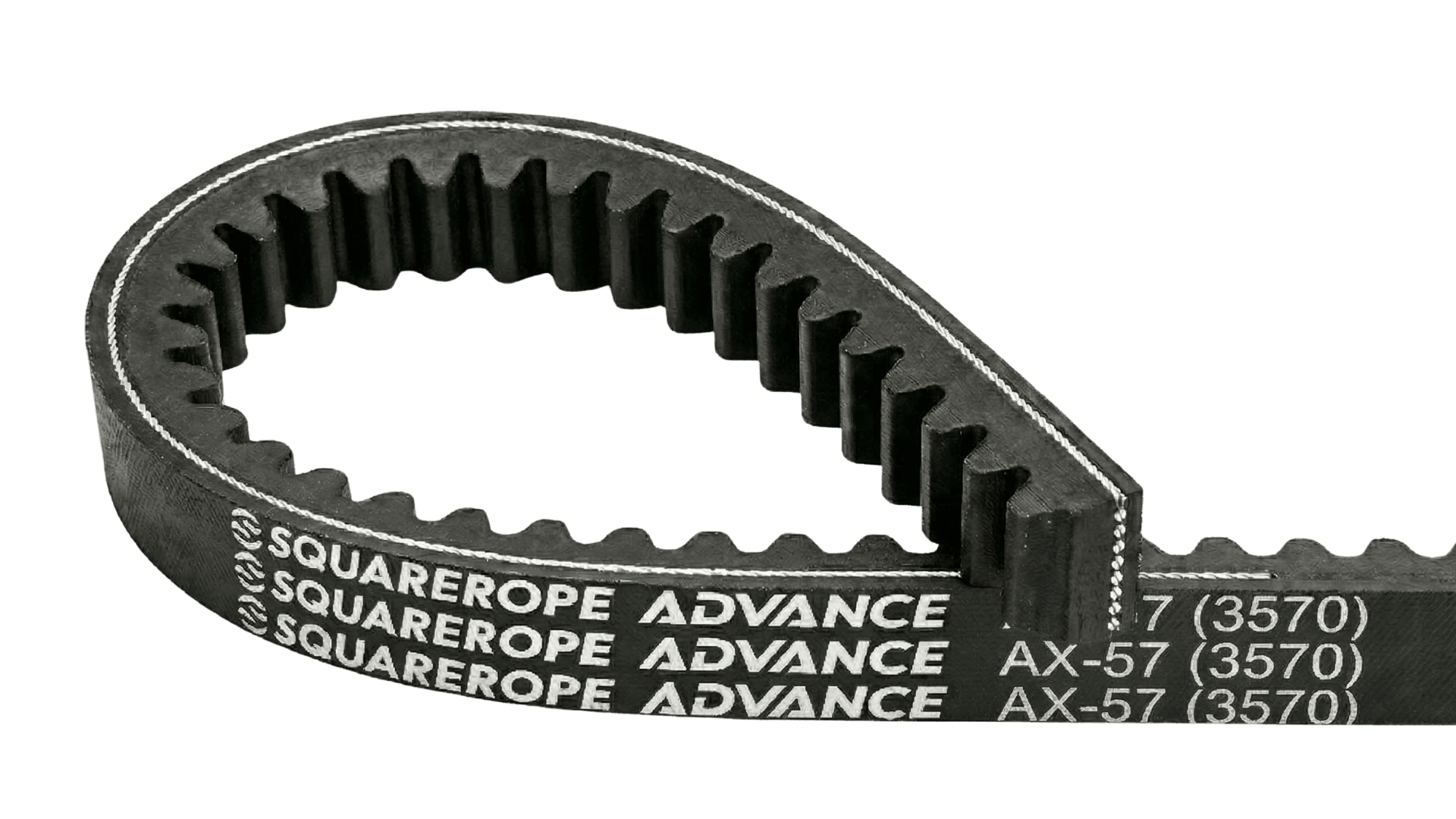
A complete industrial designation normally identifies profile, length under the maker's stated length basis, and rib count, but ordering syntax differs. Record those as separate fields with their units. Decode the marking only against that manufacturer's current catalog; a number in a product code does not by itself establish effective, reference, pitch, inside or outside length.
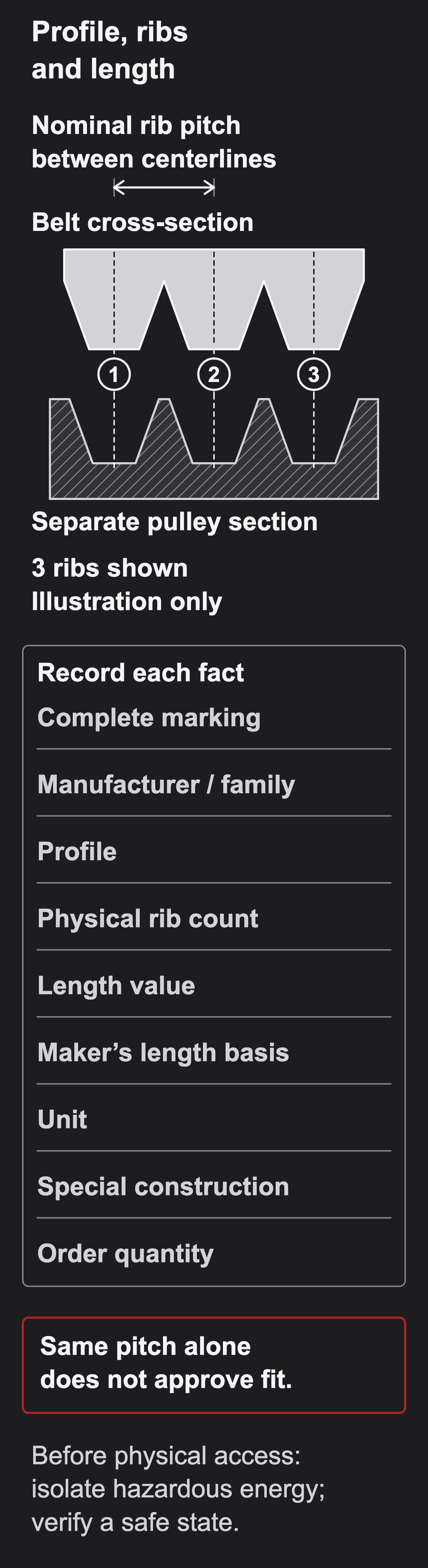
Do not replace PH, PJ, PK, PL, or PM by appearance, top width, or equipment name. Confirm the length basis and units, then verify pulley pitch, rib count, available adjustment, and whether the product is standard, elastic, double-sided, or another special construction. For profile and length identity, use Industrial V-Belt Dimensions and Length Reference Guide.
Approve every pulley, idler, and contact surface
Map every driving pulley, driven pulley, grooved idler, and flat backside idler. Record pitch or datum diameters, groove count, wrap, center distance, idler diameter, contact face, position, alignment, runout, take-up, and guard clearance. A backside idler is permitted only where the exact belt family and its backing construction allow it.
Do not claim that classical V-belts can never use backside idlers or that every Poly-V belt can use them. Do not invent spiral or reverse-face transmission from appearance. Serpentine, twisted, reverse-bend, and double-sided layouts require the manufacturer’s approved geometry, minimum diameters, speed limits, and tension method.
Calculate capacity and rib count from the exact family
Apply the chosen manufacturer’s service factor to actual running power as its design method specifies. Obtain the rating per rib from the exact family table using small-pulley diameter and speed, speed ratio, wrap, length, and every required correction. Calculate rib count by that procedure and verify belt width, pulley face width, shaft load, and bearing capacity.
More ribs can increase capacity within an approved family, but capacity is not a universal linear multiple: a six-rib belt is not automatically rated at exactly twice a three-rib belt. Do not publish a generic efficiency percentage, speed limit, noise ranking, temperature range, compound or energy saving. If a numerical performance claim is used, bind it to the exact product, test conditions and applicable evidence; do not transfer it between families. For the duty and calculation framework, use V-Belt Selection Guide: How to Specify the Correct Drive.
Inspect, install, align, and tension correctly
Use this controlled workflow:
- After verifying safe isolation, record the existing manufacturer, family, complete marking, profile, length basis, units, rib count, construction and pulley identification before removal.
- Record duty, power or torque, shaft speeds, starting behavior, cycles, daily hours, shock, vibration, environment, and failure consequence.
- With hazardous energy isolated and verified, inspect pulleys and idlers for pitch, groove count, wear, damage, contamination, alignment, and runout.
- Select the exact family with the maker’s current design tool or tables; verify rating, minimum pulley and idler diameters, maximum speed, materials, and route approval.
- Choose the approved length and rib count for the exact family, retaining the stated length basis and units; verify center adjustment, installation clearance, wrap, belt width, pulley face width and shaft load.
- Follow the exact family's installation procedure. For an adjustable-center standard belt, provide adequate slack and do not force, pry, roll or kink it. Elastic or fixed-center systems need their specifically approved installation method and tools. Under safe isolation, confirm that every rib sits in the matching groove.
- Align the pulleys and set tension with the calibrated method and target specified for that family and drive; do not use thumb pressure or a generic deflection rule.
- Reinstall the guard, restore energy under the site procedure and observe a controlled test from a safe position. Check that the belt remains correctly seated and tracks as the equipment and exact belt-family instructions require. If it runs abnormally, stop, isolate hazardous energy and verify isolation before investigating or adjusting. Follow the exact run-in or retension schedule.
Release the order only with a traceable specification
The order and maintenance record should contain:
- Manufacturer, exact product family, full designation, profile, length basis, rib count, construction, materials, and quantity.
- Driver and driven equipment, actual power or torque, shaft speeds, start method, service factor, daily hours, shock, vibration, and cycles.
- Every pulley and idler type, pitch, diameter, groove count, face, position, wrap, alignment, runout, and condition.
- Current rating-table revision, rating per rib, all correction factors, calculated rib count, belt width, and verified shaft load.
- Minimum pulley and idler diameters, maximum speed, center adjustment, installation clearance, guarding, and approved route.
- Exact-family evidence for temperature, oil, chemicals, weather, static conductivity, flame behavior, or regulated use where required.
- Calibrated tension method, target and source, installation sequence, hardware torque, run-in, retension, and inspection interval.
- Named technical approver and manufacturer or OEM confirmation wherever duty, geometry, safety consequence, or product evidence is uncertain.
A Poly-V specification is complete only when belt, pulleys, idlers, route, rating, materials, and tension all refer to the same approved system. Pitch names and generic advantages cannot replace the manufacturer’s calculation and installation data.
Key Takeaway
How do I specify a Poly-V belt?
Identify the exact profile pitch, length basis and rib count, then verify matching pulleys, route, corrected rating, materials, alignment and manufacturer tension data for one product family.
Need help verifying a ribbed drive? Review the V-Belt range and Poly-V Belt, or contact SQUAREROPE with the complete belt marking and drive measurements.