Map the drive without exposure to moving parts
Only trained, authorized personnel should inspect or service the drive. Observe routing from a safe position behind a compliant guard. Before removing a guard or touching, measuring, cleaning or adjusting, stop the machine and follow its approved energy-control procedure: isolate all hazardous energy, apply required locks and any authorized tagout procedure, control stored energy and verify de-energization.
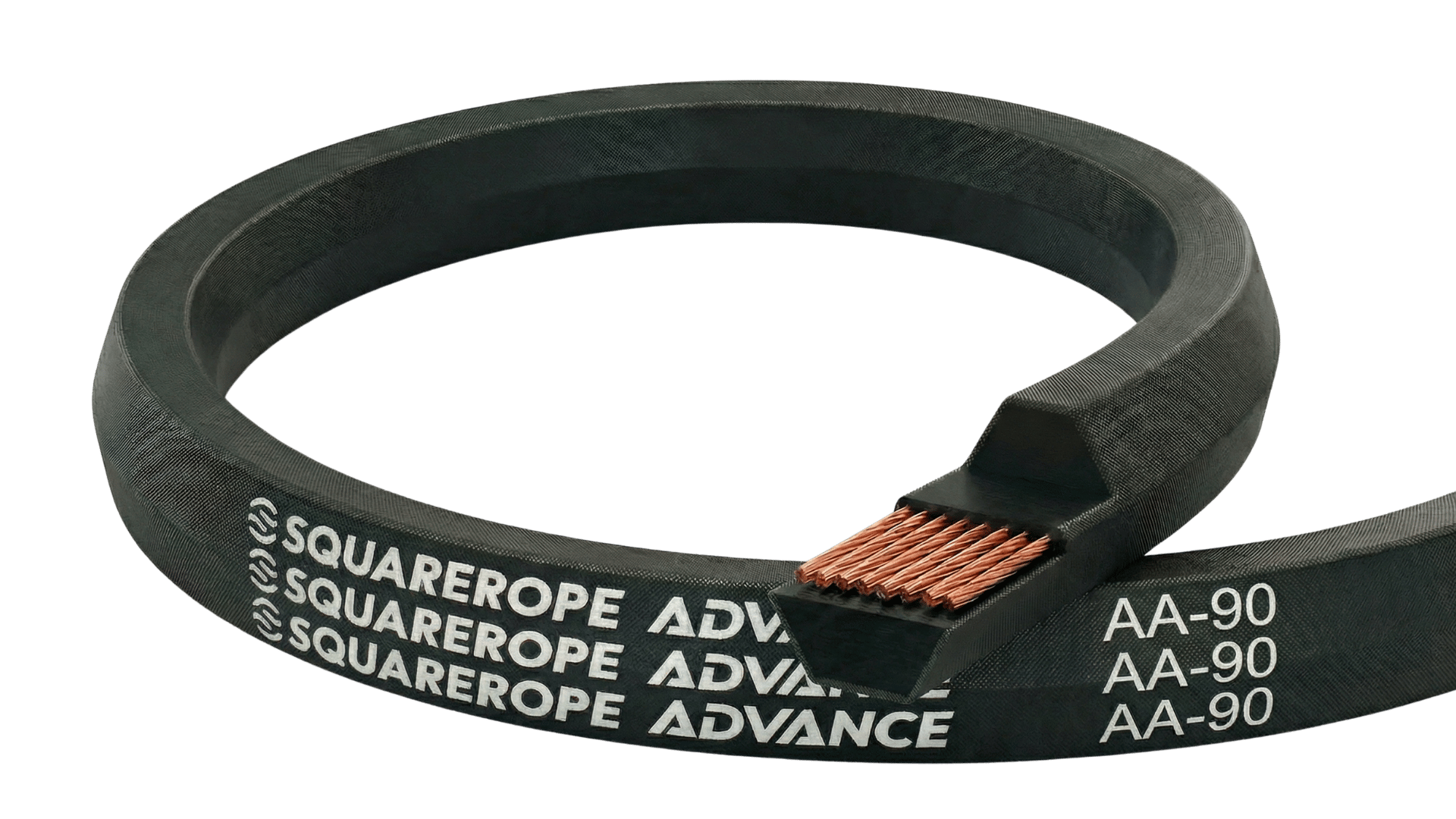
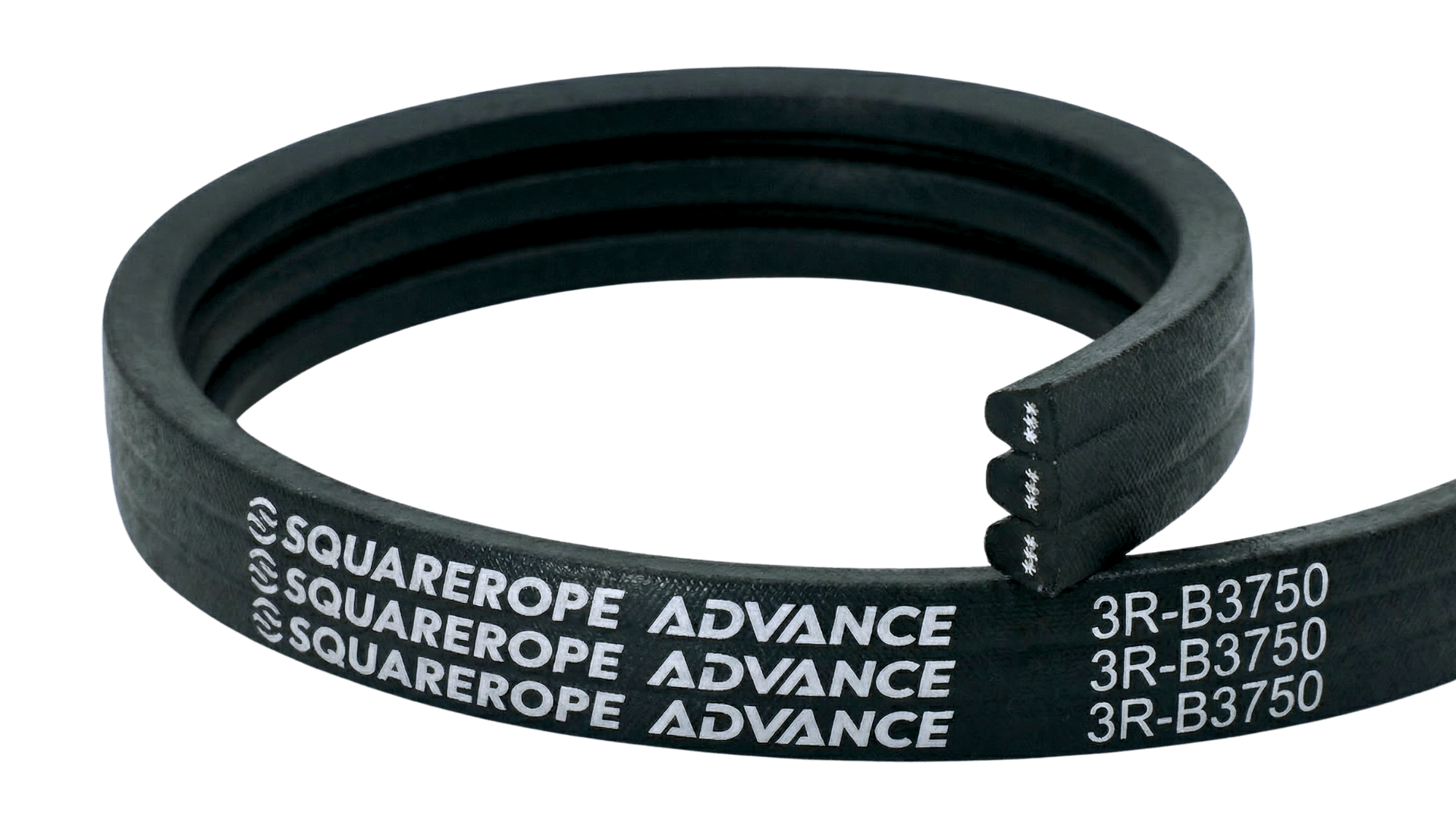
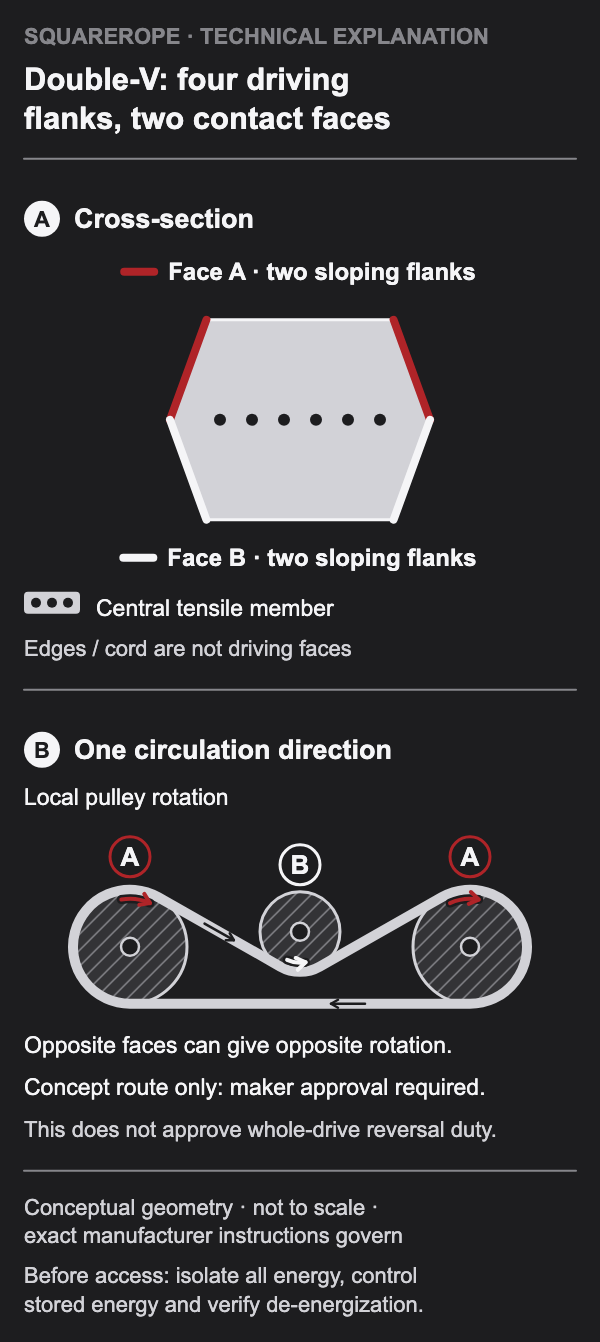
A double-V belt—also called a double-sided V-belt or hexagonal belt—has V-shaped driving flanks on both faces and a tensile member near the centerline. It can engage V-groove pulleys from alternating sides in an approved serpentine arrangement. That architecture solves a specific routing problem; it is not a universal replacement for a single-sided V-belt, a Poly-V belt, or a synchronous belt.
Understand what the double-V profile does
Power is transmitted through the sloping flanks that seat in compatible V grooves. Depending on the path, one pair of flanks drives on one pulley and the opposite pair drives on another. The belt continues to circulate in one direction while pulleys contacting opposite faces can rotate in opposite directions. This is not the same as promising identical performance during repeated reversal of the whole drive.
The hexagonal outline has four sloping driving flanks and two outer surfaces. The tensile cord and outer surfaces are not the driving flanks. A centered tensile member supports bending in alternating directions; permissible bends, load and life still depend on the exact belt family, pulley geometry, alignment, tension, duty and environment.
Separate supported layouts from unsafe assumptions
Layout decision table
A double-V belt is a candidate only where its exact manufacturer approves the path.
| Layout or requirement | Technical decision | Evidence required |
|---|---|---|
| Alternating pulley faces in one plane | Double-V may transmit from both belt faces | Maker route, pulley, wrap, diameter, rating and tension data |
| Counter-rotating driven shafts | May be achieved by contacting opposite faces | Direction diagram and complete drive calculation |
| Repeated reversal of the entire drive | Not proven by the words double-V or reversing drive | Explicit product and machine approval for the reversal duty |
| Quarter-turn or non-coplanar shafts | Do not infer suitability from the profile | Manufacturer-approved twist geometry and limits |
| Exact indexing or no-slip ratio | Use an evaluated synchronous system instead | Sprocket, tooth profile, rating and control requirements |
| Simple two-pulley V drive | A single-sided family may be simpler | Compare ratings, sheaves, environment and maintenance |
- Technical decision
- Double-V may transmit from both belt faces
- Evidence required
- Maker route, pulley, wrap, diameter, rating and tension data
- Technical decision
- May be achieved by contacting opposite faces
- Evidence required
- Direction diagram and complete drive calculation
- Technical decision
- Not proven by the words double-V or reversing drive
- Evidence required
- Explicit product and machine approval for the reversal duty
- Technical decision
- Do not infer suitability from the profile
- Evidence required
- Manufacturer-approved twist geometry and limits
- Technical decision
- Use an evaluated synchronous system instead
- Evidence required
- Sprocket, tooth profile, rating and control requirements
- Technical decision
- A single-sided family may be simpler
- Evidence required
- Compare ratings, sheaves, environment and maintenance
Source: SQUAREROPE application checklist; exact-family documentation required
Decode profile and length from the maker’s catalog
AA, BB, CC and DD are double-V profile designations, not a universal availability or interchangeability promise. Confirm the selected family’s section drawing, available lengths and ordering designation. A matching profile code alone does not establish pulley compatibility or capacity.
Record the full belt marking and the length basis specified by the selected manufacturer. Inside, outside, datum, effective and pitch length terms are not interchangeable labels. A number in a designation is not necessarily the measured circumference. Use only the exact family’s documented measurement method and conversion; do not infer a length basis from the central cord.
For section and length terminology, read V-belt dimensions and length systems; then confirm the selected double-V family’s measurement basis.
Verify every pulley and bend
Each pulley presents a compatible V groove to the belt face that contacts it. Draw the driver, driven pulleys and idlers; record contact face, diameter and its reference basis, groove profile, wrap, center distance, position, alignment, runout, take-up and guard clearance.
Use only the pulley groove system and minimum diameters approved for the exact belt family. An ordinary compatible V-groove pulley may be specified by the manufacturer; “standard V-belt sheaves will not engage” is not a safe universal rule. Reverse bends, idlers, twists and multiple driven pulleys each need explicit geometry and rating coverage.
Rate the exact belt family and drive
Apply the selected manufacturer’s service factor and rating procedure to actual running power. Capacity depends on the exact family and profile, smaller pulley diameter and speed, wrap on each loaded pulley, belt length, number of bends, duty, and every required correction. Verify shaft and bearing loads plus the specified tension and run-in procedure.
Confirm construction and environmental limits from the selected finished-belt family’s current documentation. Compound name alone does not establish temperature limits, oil or chemical compatibility, weather resistance, electrical conductivity, flex life or efficiency. Obtain product evidence for the actual exposure and any regulated use; do not infer SQUAREROPE performance or certification from another manufacturer’s data.
For rating inputs and calculation checks, read V-belt selection and calculations; use the selected double-V family’s rating method and corrections.
Build the specification from measured geometry
Specify in this order:
- Record the existing manufacturer, family, full marking, profile, length basis and quantity before removal.
- Draw the complete belt path and mark which face contacts every driver, driven pulley and idler, plus each pulley’s rotation direction.
- Record actual power or torque, shaft speeds, start and reversal duty, daily hours, shock, pulsation, vibration, braking and failure consequence.
- Measure pulley groove profiles and diameters, wrap, center distances, alignment, runout, idler positions, take-up, shafts, bearings and guarding.
- Document temperature, dust, debris, water, oil, chemicals, outdoor exposure, static or hazardous-area requirements.
- Select one manufacturer’s exact double-V family and confirm the path, profile, standard length, pulley compatibility, minimum diameters and speed.
- Apply its service factor, rating tables and corrections; verify capacity, belt count, shaft load, calibrated tension and run-in instructions.
- Obtain manufacturer or OEM approval for reversal duty, twists, quarter-turns, unusual idlers, critical service or any data outside the catalog.
Release the order only with complete evidence
The purchasing and maintenance record should contain:
- Manufacturer, exact double-V family, full designation, profile, length basis, construction, materials and quantity.
- Route drawing with contact face, direction, pulley or idler role, groove profile, diameter, wrap and position.
- Driver and driven equipment, power or torque, shaft speeds, start, reversal, service factor, operating hours, shock and vibration.
- Pulley and idler condition, alignment, runout, center distances, take-up, shaft and bearing condition, and guard clearance.
- Current rating-table revision, all corrections, calculated capacity, belt count and verified shaft load.
- Exact-family environmental, chemical, static, flame or regulated-use evidence where required.
- Calibrated tension target and source, installation procedure, hardware torque, run-in, retension and inspection interval.
- Named technical approver and manufacturer or OEM confirmation for nonstandard paths or safety-critical service.
Choose a double-V belt because the measured path needs compatible V-groove pulleys to be driven from alternating belt faces—not because a machine name, a chronic failure, or a generic “reversing” label suggests it. The path, rating, pulleys, materials and tension must all belong to one approved system.
Key Takeaway
When should I use a double-V or hexagonal belt?
Consider one when an approved coplanar serpentine path must drive compatible V-groove pulleys from alternating belt faces. Verify the exact profile, path, rating, pulleys, materials and tension with the manufacturer.
Need help validating a double-sided drive? Review the V-Belt range and Double-V Belt, or contact SQUAREROPE with the route drawing, belt marking and drive measurements.